Torch Flashbacks Torch Talk Interview with Mick Foley: On his longevity in the business, his wife's attitude toward in-ring risks, long-term plans
Apr 28, 2008 - 1:34:57 PM
PLEASE TAKE A MOMENT TO BOOKMARK US & VISIT US DAILY
The following is an interview from November 1997 with Mick Foley. It is the seventh and final installment of a multi-installment series originally published in the Pro Wrestling Torch Newsletter. The entire interview is available for PWTorch VIP members in the Torch Talk Library.
Torch Talk with Cactus Jack, pt. 7
Original Headline: Cactus Jack on his future
Originally Published: December 31, 1994
Torch Newsletter #314
This is the seventh and final installment of a "Torch Talk" with Cactus Jack conducted Nov. 2, 1994. Jack talks about his days in WCW, absorbing the blows he does, his wife's attitude on his in–ring risks, and his long–term plans beyond wrestling.
Wade Keller: Are wrestlers treated any differently today than before?
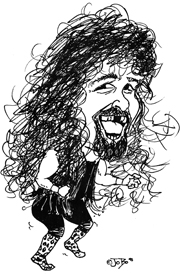
Mick Foley [artist Joseph Borzotta (c) PWTorch]
Cactus Jack: I have to compliment WCW. As far as injuries being taken care of, they were really good. They were the first ones to put wrestlers in a place where they were treated with the respect they deserved. Other times guys were forced to wrestle with injuries because they had to. That's a little bit barbaric. There's no way wrestling could get the respect it deserved. I mean, here are wrestlers out there barely walking, doing it not because of the love of the sport but because they had to. As far as some guys saying that's the way it was in the old days, as far as I'm concerned, the old ways were wrong. It's good that today there are more wrestlers investing their money and developing side businesses and even pursuing the Lloyds of London thing, although I think that's not really an option anymore. I think wrestlers are looking at themselves more like guys who are put in a position to make a lot of money for a short period of time and they better do something with it rather than people thinking the business owes them a living and they're going to be here forever.
Keller: In five years, if you're no longer involved in wrestling, what do you see yourself doing?
Cactus: I've got a leather business on the side. It's a way to make a little money off of what I've done in the past few years, but 20 years from now I'm not going to be looking forward to selling leather jackets by mail. This may sound greedy, but I hope to in the next few years while still being a vital part of the creative side of wrestling, I really want to make enough money so I can do whatever I want the next 30 years and not worry about the money. It may sound corny, but I'd like to do something where I can help people because I think I'm pretty good at it.
Keller: What are your wife's thoughts on your longevity in the business?
Cactus: She worries about the style because she's seen the shape I've come home in and she's been on the receiving end of some hospital phone calls and she wonders how much longer I can do it. She's really worried how much longer I can do it. She's thinking the kids aren't going to have a dad to play with. But she also realizes that it's something I love and it's something I'm pretty good at and I've been coming home okay. The Sabu matches worry her a little bit and probably rightfully so. Sometimes she's worried about not what my body can stand but my head. It's been jolted a few times. With her modeling she may be able to pick up some of the slack as far as making a living. We've been looking for a business to do together. We had the modeling thing a few years ago with me as the world's ugliest receptionist. Hopefully there will be something we'll find that we really both like doing, whether it is helping people or some other avenue.
I'm lucky because ten years ago I wanted to be a wrestler. That was my dream. Right now I'm a wrestler and I've done well at it. At one point I remember my goal was to have just one wrestling match. I said, "Man, if I can wrestle one match I'd be happy." Then after I had that one match I said, "Now I want to wrestle at this place," or "Now I want to become a good wrestler." Basically, I've realized every goal I've set out for myself. So basically you keep making the goals and setting them further and further. Sometimes it leads to disappointment, but anybody who really succeeds at anything has set big goals.
I remember Magic Johnson saying, Don't ever give yourself something to fall back on because then you'll fall back on it. I thought to myself that was kind of an ignorant thing to say because he's basically telling all of their fans, Okay, a hundred of you guys go out and go blindly after one goal and one of you will get to it and the other 99 will end up crushed and devastated and have ruined your lives in pursuit of that goal. It just seemed like an ignorant thing to say. So as far as I'm concerned, yeah, I would love to sell out Budokan Hall. I'd love to be an even bigger force in wrestling. I'd love to be one of those crossover wrestlers who more than just your wrestling fans will notice, but if it doesn't happen, basically I've fulfilled and surpassed anything that anybody expected of me. I'm really pretty proud of what I've done. I've got enough videotapes that I'll be able to show my kids. I think enough people realize how hard I've worked. I've got fans who appreciate it. I've got a family that I love to be around. I really am pretty happy.
Keller: You spoke earlier about your wife worrying about your head. How does your head survive being hit with a bottle five or six times?
Cactus: I don't know. It really should have knocked me out.
Keller: After the third or fourth attempt by Sabu to break it over your head, were you tempted to say, "Okay, this is enough. It's not going to break. Let's do something else."
Cactus: No. I basically thought I'm going to stick my head out. I'm not going to be another athlete to lose the battle with the bottle. It kind of became a quest by then. There are some sick things that wrestlers think of during the course of their matches.
Keller: Later that evening or the next day did you have a huge lump, did you have to visit the hospital, did you actually suffer amnesia?
Cactus: I had several lumps. It was a real tender thing. I would just like to see it on the TV because I heard it was pretty good. That may be either a gutsy or sick thing depending on how you look at it. The performance Sabu put on under the circumstances was about the most amazing thing I ever saw. I was on a radio show in Las Vegas and I was basically talking about - I'm sure your readers are sick of this interview because I'm sure we're up to about the seventh installment by now - but I always remember when I was a kid, four of five years old, and seeing Willis Reed limping out onto the floor in 1969 or '70, sinking two jumpshots and helping the Knicks win the World Championship. People call that a profile of courage. Sure it was. But I don't think they realize that you've got guys in a sport that isn't even considered a sport who night in and night out show just as much guts as these heroes in other sports ever did.
I went on the radio and said one of the things that always bothered me about WCW was nobody it seemed ever gave me credit. It was too difficult to imagine that somebody had enough guts to go out there night after night and do things even though their body was racked with pain, so the announcers tended to trivialize it. They'd either say that you love the pain or that you didn't feel the pain. The truth was I didn't love it and I definitely felt it. Cactus Jack, to the people as a wrestler and as a drawing card to WCW, would have been a lot more valuable if they would have put over the fact that they basically had a guy out there who would sacrifice himself for the people rather than portraying him as a freak of nature because I'm not.
Keller: Even during one of your matches with The Nasty Boys, Tony Schiavone and Jesse Ventura were laughing throughout your match. What was your reaction when you found out that is what they did?
Cactus: Jesse came up to me in the dressing room afterward and said, "I know you guys are going to be mad at me, but I couldn't stop laughing because I had never seen anything like it in my life." If he would have told that to the people I would have been a little happier. He said that to us, but he didn't say it over the air. He said, "That was one of the wildest matches I've ever seen." I don't think the announcers ever gave me my fair share as far as that was concerned. That makes it kind of tough to get sympathy as a babyface when the people are led to believe that you love pain. I would go on my interviews and talk about how hurt I was and how banged up and then all of a sudden my match would start and I'd hear the announcers talk about how much I loved it. It kind of makes you think apparently they're not listening to the show.
Keller: In WCW, did you feel comfortable walking up to Tony Schiavone and saying, "This is the direction I want to go in?"
Cactus: I probably did that more than anybody. There were a lot of times when I would mention something to an announcer and they would put it over like a million bucks. But they never quite got that pain thing.
The point I was getting to. I think it's easier for anybody to justify what they see by saying, "Hey, he doesn't feel it," or, "Awe, he loved it." That was kind of the same way when I started hearing about the stuff Sabu did. I was like, "Obviously the guy's a freak." Then I saw him impaled on the guard rail and I went over to pick him up and the guy was devastated. The fact that the guy got up and not only got back in the ring, but completed what was for its own reasons a great match was a testament in courage. I don't mean to sound corny, but you have one guy in the ring who lost his ear and kept wrestling, which was never touched on, and you have another guy in there who has just shattered his ribs and can hardly walk, but is completing one of the better matches of the year.
I think if the general public was exposed to the fact that these aren't guys who are out there throwing fake punches and goofing around and making fun of the public, but these are guys who are every bit as heroic as the football players and hockey players and what not, then I think you can build an audience.
THE TORCH REACHES MORE COMBAT ENTERTAINMENT FANS THAN ANY OTHER SOURCE
PWTorch editor Wade Keller has covered pro wrestling full time since 1987 starting with the Pro Wrestling Torch print newsletter. PWTorch.com launched in 1999 and the PWTorch Apps launched in 2008.
He has conducted "Torch Talk" insider interviews with Hulk Hogan, The Rock, Steve Austin, Kevin Nash, Scott Hall, Eric Bischoff, Jesse Ventura, Lou Thesz, Jerry Lawler, Mick Foley, Jim Ross, Paul Heyman, Bruno Sammartino, Goldberg, more.
He has interviewed big-name players in person incluiding Vince McMahon (at WWE Headquarters), Dana White (in Las Vegas), Eric Bischoff (at the first Nitro at Mall of America), Brock Lesnar (after his first UFC win).
He hosted the weekly Pro Wrestling Focus radio show on KFAN in the early 1990s and hosted the Ultimate Insiders DVD series distributed in retail stories internationally in the mid-2000s including interviews filmed in Los Angeles with Vince Russo & Ed Ferrara and Matt & Jeff Hardy. He currently hosts the most listened to pro wrestling audio show in the world, (the PWTorch Livecast, top ranked in iTunes)
REACHING 1 MILLION+ UNIQUE USERS PER MONTH
500 MILLION CLICKS & LISTENS PER YEAR
MILLIONS OF PWTORCH NEWSLETTERS SOLD
PWTorch offers a VIP membership for $10 a month (or less with an annual sub). It includes nearly 25 years worth of archives from our coverage of pro wrestling dating back to PWTorch Newsletters from the late-'80s filled with insider secrets from every era that are available to VIPers in digital PDF format and Keller's radio show from the early 1990s.
Also, new exclusive top-shelf content every day including a new VIP-exclusive weekly 16 page digital magazine-style (PC and iPad compatible) PDF newsletter packed with exclusive articles and news.
The following features come with a VIP membership which tens of thousands of fans worldwide have enjoyed for many years...
-New Digital PWTorch Newsletter every week
-3 New Digital PDF Back Issues from 5, 10, 20 years ago
-Over 60 new VIP Audio Shows each week
-Ad-free access to all PWTorch.com free articles
-VIP Forum access with daily interaction with PWTorch staff and well-informed fellow wrestling fans
-Tons of archived audio and text articles
-Decades of Torch Talk insider interviews in transcript and audio formats with big name stars. **SIGN UP FOR VIP ACCESS HERE**